
When we talk about contract testing, it often looks and sounds more complicated than it actually is. The term itself has grown layers of jargon over the years, which is why many teams either misunderstand it or avoid it altogether.
At its core, contract testing is simply about verifying that two systems can reliably communicate with each other—without having to deploy and run both systems at the same time.
To understand it clearly, in this article we’ll discuss how contract testing helps to place them in context alongside other testing levels.
Let’s talk about unit tests first; they work on a single function or method. It checks whether a small piece of logic behaves correctly in isolation. Unit tests are fast, deterministic, and sufficient for validating internal logic. The only problem is that they stop at the boundaries of a single codebase.
On the other hand, a contract test operates one level above unit tests. It is concerned not with internal logic, but with how one service will interact with another service.
If you are a restaurant and it depends on the chef, a contract test allows you to define and verify what that interaction will look like—even if chef is not working or not yet hired.
In practical terms, this means you can simulate chef’s expected behavior based on an agreed contract. If you specify:
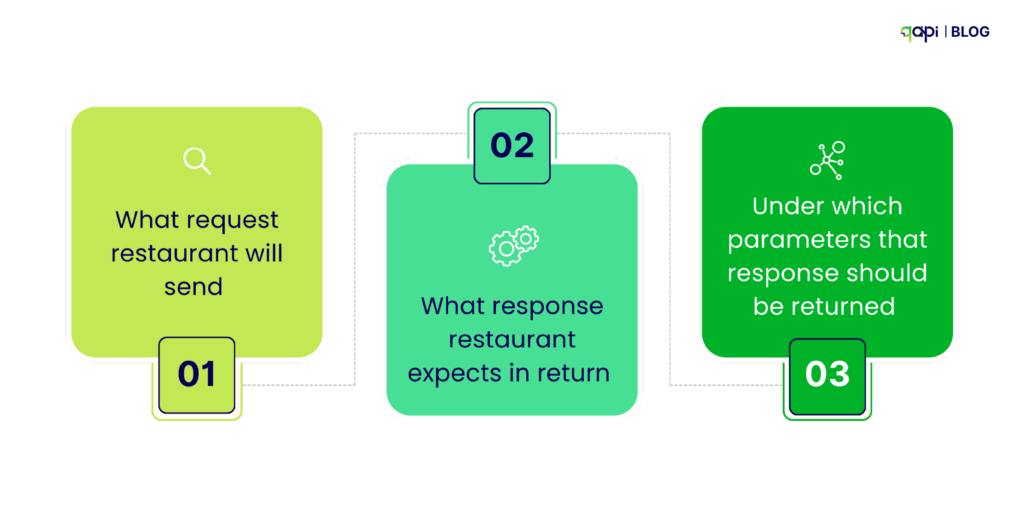
• What request restaurant will send
• What response restaurant expects in return
• Under which parameters that response should be returned
If chef later changes something(like the menu) that violates this agreement—such as removing a field, changing a response code, or altering behavior—the contract test fails immediately.
You can see the breakage early, clearly, and in isolation, rather than finding it days later during integration testing or, worse, in production.
This is why teams need to realize the value of contract testing: it detects communication failures before services are integrated.
What is the difference Between Contract Tests and Integration Tests
A common point of confusion is the difference between contract tests and integration tests.
With an integration test requires both restaurant and chef to be fully implemented, deployed, configured, and running. It validates that real services can talk to each other in a real environment.
While integration tests are valuable, they are comparatively slower, fragile, and harder to debug because failures can be caused by environment issues, data setup problems, or unrelated changes in either service.
Contract tests completely avoids these problems. They allow each service to be tested independently, based on a shared agreement.
This makes contract tests faster, more reliable, and more easier to maintain as time passes, especially in microservice architectures where dozens or hundreds of services can grow at once.
Now, let’s clear the air by explaining how schema tests are different
Why Schema Tests Are Often Mistaken for Contract Tests?
We see many QA teams believing they are doing contract testing because they validate API schemas. This is an understandable mistake—but it is still a very big mistake.
Why? Because schema tests verify structure, not behavior. They can confirm requests and responses to a defined format: correct data types, required fields present, and to check if allowed values are respected.
This is useful, but it does not prove that two systems actually agree on how the API should behave in real scenarios.
A schema test will tell you that a field exists. A contract test shows you when and why that field matters.
For example, a schema might say that a status field is optional. A consumer, however, may rely on that field being present to drive business logic. Removing it may still pass schema validation—but it will break the consumer. Schema tests won’t catch this. Contract tests will.
This is why it is worth researching deeper whenever schema validation is being treated as “contract testing.” Without setting strong interaction expectations, teams are only validating grammar – not meaning.
Let’s understand how contract testing actually addresses this challenge in the real system.
The Core Principles of Contract Testing
It’s no surprise: Independent verification is the first principle. Instead of waiting for all services to be deployed and tested together, each service verifies its responsibilities independently.
This reduces feedback cycles and prevents late-stage surprises.
Your Consumer–provider contracts is the second principle.
The consumer states what it needs, and the provider ensures it can meet those needs. If both sides satisfy the same contract, integration should and will work as expected.
Backward compatibility protection is another critical upside that teams can get. Contract tests make it immediately visible when a change—such as removing a field or altering a response—will break existing consumers.
This helps teams to evolve APIs safely instead of relying on assumptions about “non-breaking changes.”
Finally, automation is essential. Contract tests are most effective when they run automatically as part of your CI/CD pipeline. Every change is validated against existing contracts, ensuring that breaking changes are caught early, when they are cheapest to fix.
Why Contract Tests Belong in the Testing Pyramid
For a large majority of testers and developers contract tests often feel like they don’t fit neatly into the traditional testing pyramid.
But that’s mostly because the pyramid was designed for monoliths, not for distributed systems.
In architecture systems we see now, contract tests act as the bridge between unit tests and integration tests. They reduce the need for excessive end-to-end testing while still providing strong system compatibility.
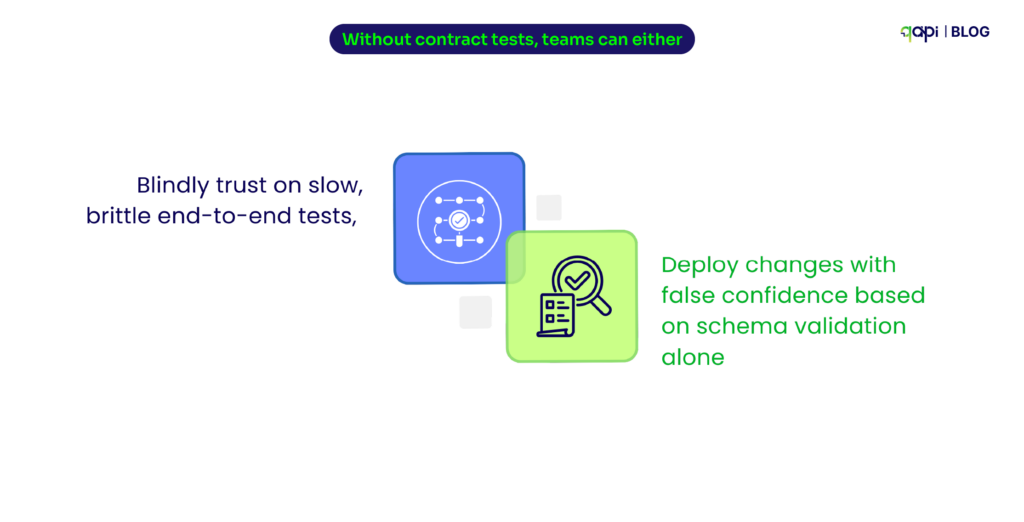
Without contract tests, teams can either:
• Blindly trust on slow, brittle end-to-end tests, or
• Deploy changes with false confidence based on schema validation alone
Neither of these options are good for business.
The Real Goal of Contract Testing
Contract testing is not about adding more tests. It is about reducing uncertainty.
When done well, contract tests allow teams to:
• Develop services in parallel without fear
• Detect breaking changes before integration
• Scale APIs without slowing delivery
In other words, contract tests exist to answer one simple but critical question:
“If this service changes today, who or what will it break tomorrow?”
Once teams understand that you will have no backlog and no burnout.
How Contract Testing Works in Practice
At a high level, contract testing follows a Consumer-Driven Contract (CDC) approach. This means the system that uses an API defines what it needs, and the system that provides the API proves it can meet those expectations.
Let’s walk through what this looks like step by step.
Step 1: The Consumer Defines Its Expectations
Everything starts with the consumer—because in distributed systems, breakage is always seen by the consumer first.
When you’re building Service A and it depends on Service B, you already have assumptions in your head:
• Which endpoint you’ll call
• Which fields you rely on
• Which response codes you handle
• Which error cases matter
Contract testing simply makes those assumptions clear.
From a developer’s perspective, this usually happens inside consumer tests. You write tests that simulate calling Service B, but instead of hitting a real service, you describe the interaction in a contract format—often as a pact file or schema-backed interaction definition.
This contract includes:
• The HTTP method and endpoint
• Required headers or auth behavior
Example request payloads
• Expected response status codes
• Required response fields and their meanings
At this stage, you are not testing whether Service B actually works. You are documenting what you expect it to do.
Step 2: Consumer Tests Generate and Publish Contracts
Once these consumer tests run, they generate a contract which is usually a machine-readable file that describes the expected interactions.
This file can prove everything. It is sent to a contract repository or broker that both teams can access. Importantly, this happens automatically as part of the consumer’s CI pipeline.
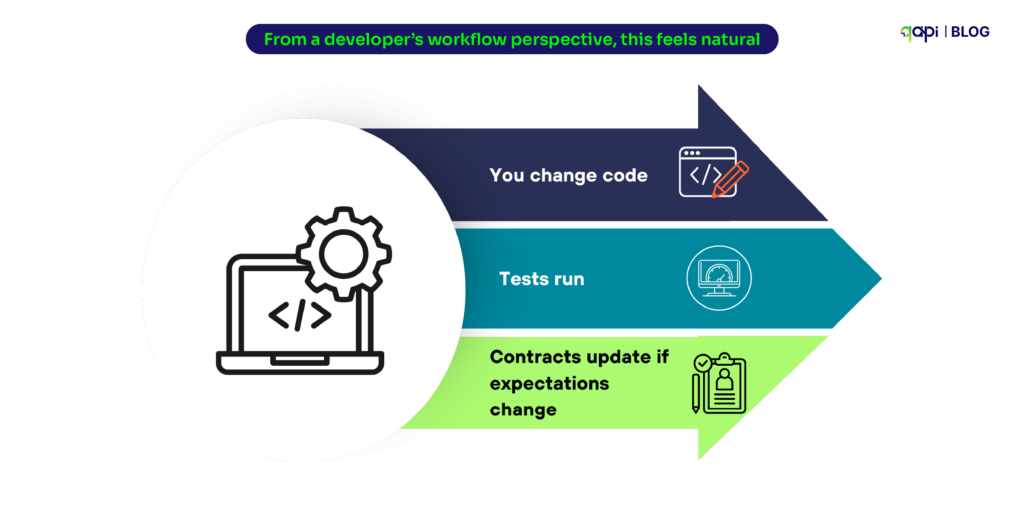
From a developer’s workflow perspective, this feels natural:
• You change code
• Tests run
• Contracts update if expectations change
If you intentionally modify how you use an API.
For example, let’s say you start relying on a new field—that change is reflected immediately in the contract.
No meetings, no emails, but you have results.
Step 3: Providers Verify Against the Published Contracts
Now the responsibility shifts to the provider.
When service B pulls the published contracts and runs provider verification tests, these tests check whether the provider can satisfy every contract that consumers can depend on.
If the provider passes verification:
• It has proven that it still supports all existing consumers
• It is safe to deploy from a contract perspective
If verification fails, it means something meaningful:
• A field was removed
• A response code changed
• Behavior no longer matches expectations
At this point, developers have clear options:
• Fix the provider to restore compatibility
• Update the consumer and version the API
• Introduce backward compatibility logic
The failure is early, isolated, and actionable—which is exactly what you want.
Step 4: Resolving Issues Without Slowing Teams Down
One of the biggest advantages of contract testing is how cleanly it handles mismatches.
Instead of discovering breakage during integration or production testing, teams can respond deliberately:
• Providers can introduce non-breaking extensions
• Breaking changes can be gated behind new API versions
• Consumers can migrate incrementally
This turns API evolution into a controlled process instead of a risky guessing game.
Handling Multi-Version APIs and Feature Flags
Real systems don’t stand still, and contract testing supports that reality well.
When APIs grow, contracts can be versioned alongside code. Older contracts remain valid until consumers migrate, while new contracts define new behavior. Providers can support multiple versions simultaneously and verify compatibility independently.
Feature flags add another layer of safety. New behavior can be introduced behind a flag, with contracts clearly written for that path. Once consumers are ready, the flag can be rolled out confidently—knowing the contract has already been validated.
It’s all about reducing risk without reducing speed. As it allows you to:
• Refactor APIs safely
• Deploy independently
• Avoid breaking consumers you don’t even know exist
• Replace guesswork with executable agreements
When contract testing is in place, API changes stop being scary. They become routine, predictable, and boring—in the best possible way.
Isnt’ that what you and your team needs?
And now, the testing industry needs to take the next logical step: Letting a smart tool to fill the gap.
How qAPI Makes Contract Testing Simple
qAPI removes the manual work from contract testing. That means you don’t have fuss about the work needed for running tests, qAPI can provide all that and support 24×7 for all your API testing needs
With qAPI, teams can:
• Generate contracts directly from OpenAPI specs
• Auto-create contract tests for requests and responses
• Validate schema changes on every build
• Run contract tests in CI/CD without writing code
• Share contracts across teams in one workspace
When a change breaks the contract, qAPI flags it instantly—before it reaches production. So have complete visibility on what’s happening, less doubt and more confidence. It’s easy to be a skeptic, there’s so much to care and figure out about: API privacy, data safety and what not.
After all, the stakes are always high, it’s just the technicality that’s overly bloated contract testing is necessary and it can be a cakewalk without any serious implications.
You can take care of your APIs and contract tests all one place with qAPI.