Executive Summary 

Healthcare as a sector is actively accelerating their adoption of API-driven architectures to support interoperability, digital patient engagement, and data exchange across ecosystems. Standards such as HL7 and FHIR, combined with REST-based services, now are quite critical for clinical and operational workflows. 

This shift has exposed structural gaps in testing, security, and governance. While many organizations continue to rely on fragmented or manual API validation processes. It has resulted in increased exposure to integration failures, security incidents, and regulatory non-compliance. 

At the same time, external pressures—including rising ransomware activity, supply chain dependencies, and evolving data sovereignty regulations—are adding to the risk appetite and making it difficult for companies to survive. Because APIs have become a primary control point where these risks converge. 

This case study explains how our customer a mid-sized healthcare provider implemented an AI-assisted, contract-aware API testing approach with qAPI to address these challenges. Read the complete story on how API testing with qAPI helped them evolve from a tactical activity into a strategic capability supporting resilience, compliance, and operational efficiency. 


Recent industry data clearly shows why the urgency of addressing API led risks were completely valid: 

• Approximately 78–79% of healthcare organizations report at least one API security incident annually  

• Healthcare remains the most expensive sector for data breaches, with average costs exceeding $9–10 million per incident  

• Nearly 50% of organizations lack formal API discovery processes, limiting visibility into exposed endpoints  

• Traditional testing approaches struggle to scale with distributed, hybrid, and API-driven architectures  

At the same time, regulatory pressures around data sovereignty, localization, and cross-border data flows are increasing, adding further complexity to API governance and validation. 

About Our Client 

Our customer operates three acute‑care hospitals and multiple outpatient clinics with an enterprise EHR, ancillary systems, telehealth, and payer connectivity, supported by more than 150 internal and external APIs. Some systems are on‑premise; others are hosted on cloud platforms or managed by third‑party vendors, mirroring the increasingly hybrid, globally distributed infrastructure described in cloud‑migration studies.  

They needed to transform how they handled their data and how they had set-up their API testing system. Their existing process relied heavily on manual testing and deep institutional knowledge to analyze customer data, scan reports, doctor’s thoughts, automated medicine schedule and etc. They needed to streamline, secure and scale their API systems to stay safe from external intrusion and maintain. The tech stack they were using:  

• EHR interoperability (HL7 v2, FHIR REST APIs, DICOM). 

• Telehealth platforms and remote monitoring, which exchange visit summaries and vital data with EHRs. 

• Patient‑facing mobile apps for records access, scheduling, billing, and messaging. 

• Payer and clearing house connectivity for eligibility, claims, and prior authorization. 

They wanted to fix the following KPIs: 

– Discover and catalog APIs across EHR, telehealth, and integration layers, including shadow and partner APIs. 

– Automatically generate and maintain functional, regression, contract, and security tests for HL7/FHIR and REST endpoints. 

– Embed resilience, negative, and geo‑aware tests into CI/CD to anticipate both technical failures and geopolitical disruptions. 

– Reduce manual test creation and maintenance work, shorten deployment cycles, and lower the likelihood and severity of API‑related incidents, including ransomware and supply‑chain–driven outages. 

We asked: Do you a massive framework to execute this task? 

Answer: The right approach is to have a solution that fits right onto the specific use case 

Solution: Implementing qAPI for Healthcare API Testing 

In addition to its baseline capabilities, qAPI helped the healthcare provider to adapt to geopolitical and macro‑risk trends by: 

Hardening against ransomware and nationstate tactics: By continuously exercising authentication, authorization, and error‑handling paths for high‑value APIs, including those exposed to partners or the public internet, qAPI makes it harder for attackers to exploit misconfigurations or overlooked endpoints—attack vectors highlighted in recent healthcare cybersecurity research. 

Testing for cloud and supplychain resilience: qAPI can run scenario tests against failover endpoints, alternate regions, or vendor sandbox environments to validate that APIs degrade gracefully or reroute traffic when third‑party services become unavailable, an approach recommended in analyses of supply‑chain‑driven outages. 

Supporting dataresidency and sovereignty strategies: By tagging tests and endpoints with region and dataclassification metadata, qAPI enabled our customer to verify that calls in each jurisdiction to use the correct regional endpoints and do not leak PHI across borders, aligning with emerging datalocalization and geopatriation practices. 

Impact: Resilience, Compliance, and Operational Efficiency 

With qAPI added in their tech stack the AI-assisted, contract-aware API testing approach has delivered measurable improvements across Our customer’s health engineering, security, and compliance functions. In addition to previously observed gains in release velocity and reduced manual effort, the organization has achieved significant progress in resilience and risk mitigation. 

From an operational standpoint, automated testing has reduced manual testing effort by approximately 50–60%, allowing engineering teams to reallocate time toward higher-value development work.  

Release cycles have accelerated by an estimated 30–40%, driven by continuous validation of APIs within CI/CD pipelines and faster identification of integration issues. 

In terms of system resilience, contract-driven testing and automated regression coverage have contributed to a 35–50% reduction in API-related defects reaching production.  

By validating changes against predefined contracts, our customer has managed to minimize the risk of breaking changes caused by rapid configuration updates, emergency patches, or third-party dependencies.  

Additionally, the integration of end-to-end testing has improved vulnerability detection rates by up to 40%, reducing exposure to ransomware and other advanced threats. 

The solution has also strengthened compliance and audit readiness.  

Region-aware test suites have enabled consistent validation of data flows across jurisdictions, helping ensure that the company is adhering to evolving data localization and sovereignty requirements.  

As a result, audit preparation time has decreased by approximately 25–35%, with automated test documentation providing clear, verifiable evidence for regulators, partners, and payers. 

These combined improvements have shifted API testing from a reactive process to a proactive control layer. By reducing production incidents, accelerating delivery, and strengthening compliance posture, our customer has effectively transformed testing into a strategic capability—one that protects revenue, enhances system reliability, and supports operations in an increasingly complex global environment. 

About us 

qAPI, part of Qyrus, is a leading codeless API testing platform that specializes in delivering advanced cloud based testing solutions. We help businesses with innovative tools and services designed to streamline API testing, ensure reliability, and enhance application performance. Trusted by financial institutions, logistics companies, and many more worldwide, we help organizations create products and APIs they can depend on for seamless performance and integration. To learn more about our products and services, visit us at qyrus.com/qapi  
Overview 

The industry’s first neo-bank was launched in the UK to specifically cater to the demands of affluent clients—approximately 7 million professionals, entrepreneurs, property investors, and others. With a mission to deliver hyper-personalized financial products (e.g., savings, fixed deposits, lending), their growth was always dependent on rapid software releases.

The Challenge 

A Need for Change 

For any financial institution, trust is built on reliability. Our client, a leader in digital banking and financial services, prided itself on delivering seamless customer experiences. However, as their digital offerings expanded, so did the challenges of maintaining software quality.  

The institution found itself at a crossroads—struggling with lengthy testing cycles, defect leakage, and the increasing pressure to release updates faster while maintaining impeccable reliability. 

Despite the best efforts of their development and quality assurance teams, traditional manual testing methods were falling short. Bugs that escaped detection in QA often came back in User Acceptance Testing (UAT), leading to costly fixes and delays. 

With customer expectations at an all-time high, the institution took a strategic approach to rethink its API testing metrics. 

The Objective

The Roadblocks to Innovation

The bank’s testing inefficiencies stemmed from several key pain points:
  1. Heavy Reliance on Manual Testing: The majority of test scenarios required manual execution, making regression testing time-consuming and resource-intensive.

  2. Defect Leakage: Up to 65% of defects made it past QA undetected, only surfacing in UAT, increasing remediation costs and time.

  3. Extended Testing Timelines: Some releases required up to 17 weeks of testing, delaying critical updates.

  4. Scalability Challenges: As digital services expanded, the existing test framework struggled to keep up.

Recognizing that speed and accuracy were important for them, our client the bank planned for a solution that could streamline its testing efforts without sacrificing quality. 

The Solution

A Shift to AI-Powered Test Automation

The bank got a complete walkthrough of qAPI—a next-generation, AI-driven test automation platform. Designed to seamlessly integrate with existing workflows, qAPI offered a scalable, codeless solution that would transform the institution’s testing strategy. With qAPI, the bank was able to:
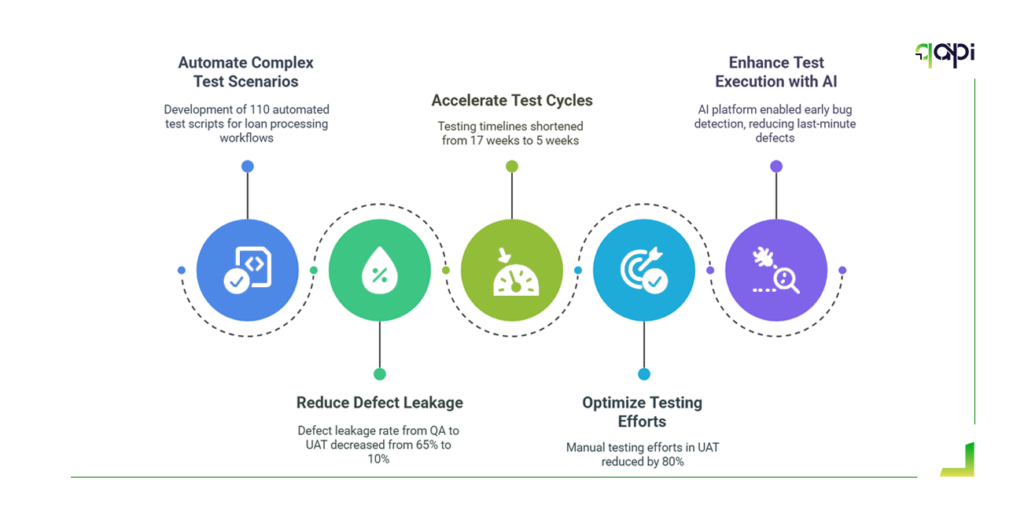
  1. Automate Complex Test Scenarios: The team developed over 110 automated test scripts tailored to complex loan processing workflows, ensuring comprehensive validation.

  2. Reduce Defect Leakage: The defect leakage rate from QA to UAT dropped from 65% to just 10%.

  3. Accelerate Test Cycles: Testing timelines were reduced from 17 weeks in Release 4 (R4) to just 5 weeks in Release 9 (R9), a 70% reduction in test cycle times.

  4. Optimize Testing Efforts: Manual testing efforts in UAT were cut by 80%, allowing testers to focus on more strategic tasks.

  5. Enhance Test Execution with AI: qAPI’ AI-powered platform enabled early bug detection, reducing last-minute defects and rework.

The Solution 

A Shift to AI-Powered Test Automation 

The bank got a complete walkthrough of qAPI—a next-generation, AI-driven test automation platform. Designed to seamlessly integrate with existing workflows, qAPI offered a scalable, codeless solution that would transform the institution’s testing strategy. With qAPI, the bank was able to: 

  1. Automate Complex Test Scenarios: The team developed over 110 automated test scripts tailored to complex loan processing workflows, ensuring comprehensive validation. 
  2. Reduce Defect Leakage: The defect leakage rate from QA to UAT dropped from 65% to just 10%.
  3. Accelerate Test Cycles: Testing timelines were reduced from 17 weeks in Release 4 (R4) to just 5 weeks in Release 9 (R9), a 70% reduction in test cycle times.
  4. Optimize Testing Efforts: Manual testing efforts in UAT were cut by 80%, allowing testers to focus on more strategic tasks.
  5. Enhance Test Execution with AI: qAPI’ AI-powered platform enabled early bug detection, reducing last-minute defects and rework.
The Impact

Delivering Measurable Impact

The implementation of qAPI transformed the financial institution’s approach to testing, yielding substantial benefits:
  1. Enhanced Efficiency: The institution automated over 550 test cases, achieving 90% test script execution on qAPI.

  2. Higher Software Quality: Early-stage bug detection led to fewer production defects and improved software stability.

  3. Reduced Operational Costs: The shift from manual to automated testing significantly lowered costs.

  4. Scalability & Security Compliance: qAPI’ cloud-based, ISO 27001 & SOC2-compliant infrastructure ensured a secure and scalable testing environment.

  5. Seamless Integration: With its intuitive, codeless interface, qAPI eliminated the need for costly custom frameworks, making adoption seamless.

Qyrus’s all-in-one platform combines AI intelligence, codeless automation, and enterprise-grade security to empower teams across the testing lifecycle: 

  1. Unified Testing: Complete end-to-end API testing on a single cloud platform. 
  2. Zero Maintenance: Pre-configured infrastructure with no setup time. 
  3. Cost Efficiency: Reduced operating costs and human errors by up to 40%

About qAPI :

qAPI is the industry’s first End-to-End API Testing company that helps organizations achieve API protection in a cloud-first, API-driven world. We help businesses with innovative tools and services designed to streamline API testing, ensure reliability, and enhance application performance. Trusted by financial institutions, logistics companies, and many more worldwide, we help organizations create products and APIs they can depend on for seamless performance and integration. 

To learn more about our products and services, visit us at www.qyrus.com/qapi/ 

Overview 

Our client has cemented its position as an industry leader by providing to timely services and maintaining public health standards for over a decade. As one of the leading North American waste handling companies, with over 50,000 employees and $15.2 billion in revenue, they recognized the need to enhance its software systems to manage tasks such as collections, waste disposal, logistics, inventory, and supply chain distribution.  

The Challenge 

Breaking Free from Legacy Testing Limitations 

As customer expectations evolved and operational demands surged, the company needed to rethink how it built, tested, and deployed its technology. Instead of relying on traditional methods, they adopted a data-centric, outcome-driven approach to overcome testing challenges. 

The digital ecosystem was built on a complex network of APIs and microservices, powering everything from customer portals to logistics management and even legacy applications. The company had two critical applications driving its day-to-day operations: a customer-facing e-commerce platform and an internal business process application.  

These systems powered everything from service requests to route optimizations, and they were evolving fast. The problem? Testing wasn’t keeping up and cost the team a lot of time. 

Manual API testing had once been sufficient, but with the explosion of new endpoints and frequent updates, the cracks started to show: 

  1. Test Coverage Gaps: The team could only validate a fraction of their API interactions, leaving potential defects unnoticed. The testing infrastructure struggled to handle the growing complexity of their API ecosystem. Traditional tools were not designed to test the intricate interactions between microservices effectively.
  2.  Slow Releases, Growing Risks: Each new release carried the risk of undiscovered bugs, as they were often discovered late in the development cycle affecting performance.
  3.  Resource Strain: With engineers stretched thin, the testing process was eating into development time, forcing teams to choose between speed and quality. 

For a company built on efficiency, this was a roadblock they couldn’t afford. 

The Objective 

Redefining The Testing Approach 

The company started to explore on the possibility of a digital transformation journey, heavily relying on API enhancement to streamline workflows. 

The leadership team knew they had to break free from the limitations of manual testing. Their goal was to implement a testing solution that could: 

  1. Accelerate Testing Cycles: Reduce the time required for API testing without compromising on quality.
  2. Improve Test Coverage: Ensure comprehensive validation of API interactions, including edge cases and error handling.
  3. Accelerate deployment cycles without sacrificing quality, ensuring every update improved—not jeopardized—user experience.
  4. Scale with Growth: Build a testing framework capable of handling the increasing complexity of their microservices architecture. 

After seeing qAPI seamlessly integrate into their processes and bring a refreshing change of pace, the waste handling company knew it was a trusted solution. Now, they were ready to turn this vision into reality. 

The Solution 

Intelligent Automation, Real-Time Insights 

With qAPI’s AI-powered, codeless API testing platform the company was able to create customized workflows designed to eliminate bottlenecks and supercharge testing capabilities.  

By leveraging automated testing, the company established a structured testing framework that enabled seamless collaboration across teams. This approach accelerated the detection and resolution of defects throughout the service journey, ensuring a more natural and effective development progression. 

The implementation helped deploy: 

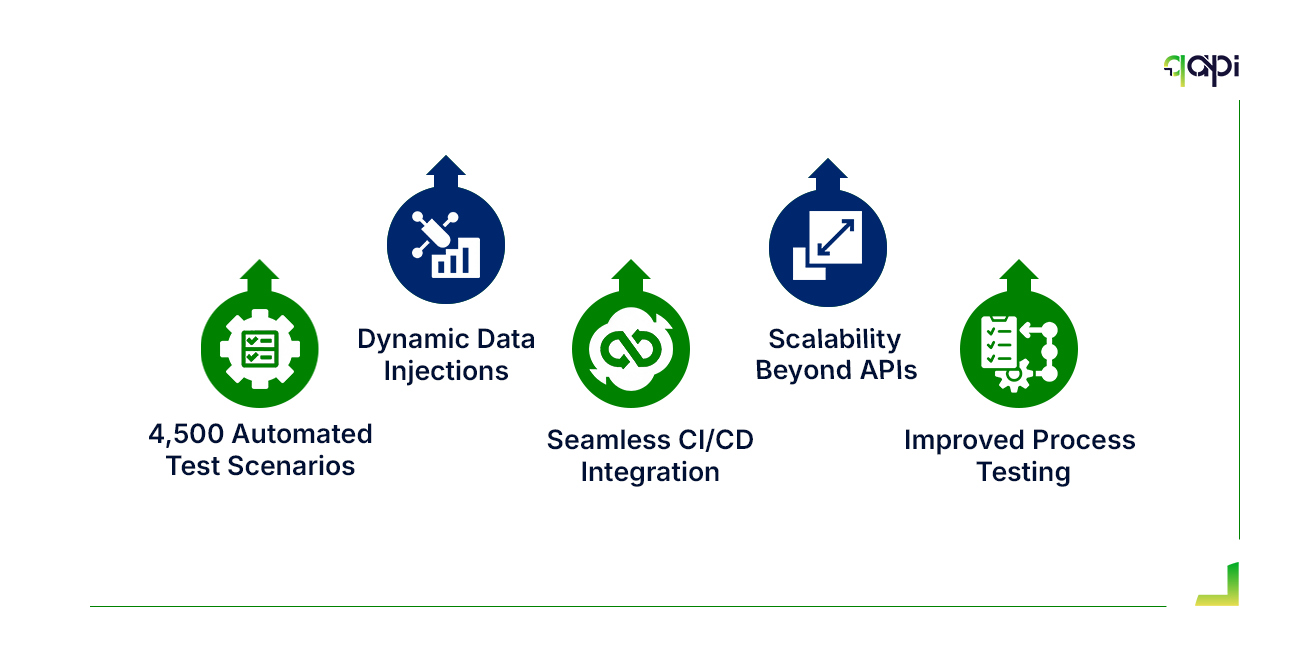
  1. 4,500 Automated Test Scenarios: Within four months, the company automated thousands of test cases, covering 400+ API endpoints across SOAP and REST architectures.
  2. Dynamic Data Injection: Unlike traditional scripts, qAPI leveraged unique, randomly generated data to simulate real-world interactions and uncover hidden vulnerabilities.
  3. Seamless CI/CD Integration: The platform integrated directly into the company’s development pipelines, enabling automated test execution with every new build. With this process in place, teams had a comprehensive report of all of their systems within minutes of finishing a new build.
  4. Scalability Beyond APIs: Encouraged by success, the company expanded automation efforts into mobile and web testing, to eventually convert into a unified testing ecosystem.
  5. qAPI Process Testing: Integrations between different applications and systems were validated after being triggered after a new build.

The Impact

Testing The Impact of Custom API Testing Strategy 

  1. Accelerated Release Cycles: Automated API testing reduced testing time by 40%, enabling faster deployment of new features and updates.
  2. Higher Software Quality: Comprehensive test coverage and early bug detection resulted in a 30% reduction in production defects, enhancing software stability and reliability.
  3. Seamless Team Collaboration: A unified testing platform improved communication and coordination across development teams, reducing misalignment and increasing efficiency.
  4. Scalability for Growth: qAPI’s scalable infrastructure ensured that the company’s testing framework could expand alongside its business, supporting long-term digital transformation.
  5. Operational Cost Savings: By minimizing manual testing efforts and late-stage defect resolution, the company significantly reduced development and maintenance costs. 

About qAPI 

qAPI is the industry’s first End-to-End API Testing company that helps organizations achieve API protection in a cloud-first, API-driven world. We help businesses with innovative tools and services designed to streamline API testing, ensure reliability, and enhance application performance. Trusted by financial institutions, logistics companies, and many more worldwide, we help organizations create products and APIs they can depend on for seamless performance and integration. 

To learn more about our qAPI