
Lorem ipsum dolor sitam etetetur
Lorem ipsum dolor sit amet, consetetur sadipscing elitr, sed diam nonumy eirmod tempor invidunt ut labore et
Get a Free Trial
Stop choosing LLMs on demos. Start choosing them based on evidence.
Built for teams evaluating LLMs for product, QA, engineering, and enterprise rollout decisions.
- Compare multiple LLMs side by side.
- Score outputs against structured criteria.
- Add your own parameters for domain-specific evaluation.
There’s no faster way, identifying the right tool needs strategy and evaluation
Start with battle-tested presets, then define your own. Each parameter links to tests, datasets, and acceptance thresholds your stakeholders agree on.
Factual Accuracy
Catch hallucinations fast. Checks answers against your docs and data, verifies citations, and flags unsupported claims.

Instruction Accuracy
Ensure models follow your rules. Tests adherence to system prompts, tone, and exact format requirements.
Reasoning Depth
Measure real thinking. Evaluates multi-step logic, math accuracy, and quality of explanations.
Latency & Cost
Balance speed and spend. Tracks response time, token usage, and cost per completed task to optimize economics.
Tool & Agent Reliability
Test real-world actions. Validates correct API calls, error recovery, and reliable handoffs in agent workflows.
Safety & Compliance
Ship securely. Scans for PII leaks, policy violations, and prompt injection resistance before production.
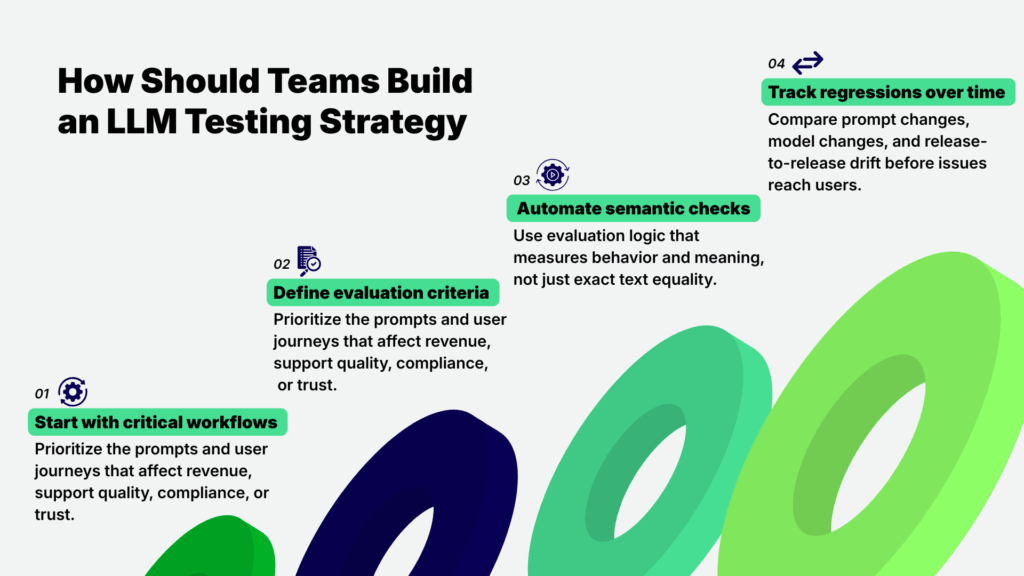
How Should Teams Build an LLM Testing Strategy
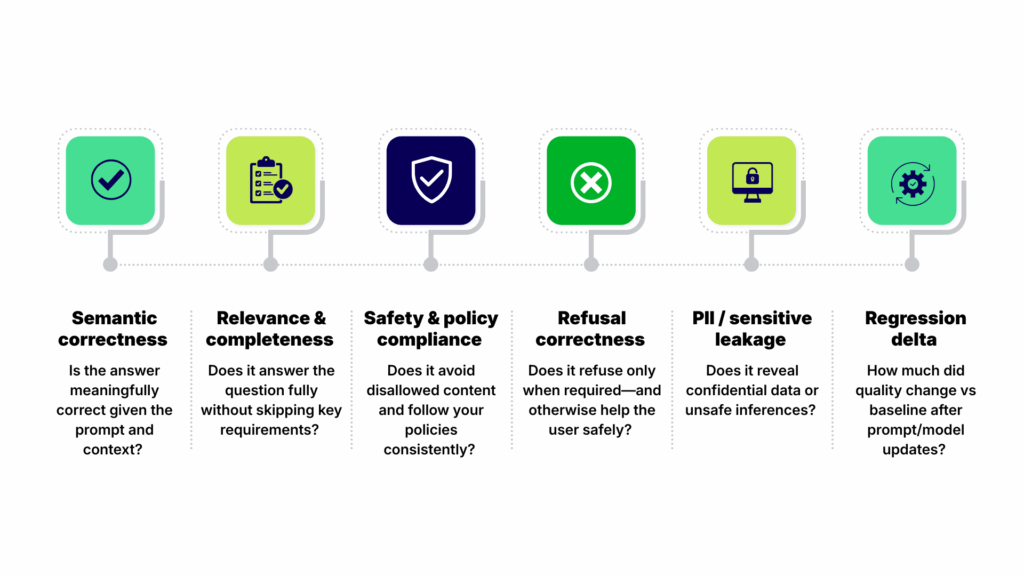
LLM evaluation metrics that matter in production
Drive products to success
We help you take a sequence of actions to execute and validate workflows between different software components via APIs. Optimize data flow between software components to enhance performance.
Accelerate Validation During UI Development
Validate End-to-End Flows of APIs
Move Ahead With qAPI
Ensure seamless API performance with a structured testing approach. Identify key workflows, create test cases for all scenarios, automate repetitive tests for consistency, and continuously monitor performance to maintain reliability as your system evolves.
Boost Functional Outcomes with API Process Testing
Enhance your QA strategy by ensuring backend stability before the UI is even considered. This approach enables faster debugging by isolating backend and UI issues, improves collaboration between developers and testers, and provides comprehensive coverage—validating both frontend and backend for a higher-quality application.
They talk about it better than us
QAPI simplified our API testing with its ability to test individual API's and API Chaining for functional and performance testing. QAPI's AI integration capability allows recording of API's with API Discovery extension and generation of API assertions which is of great help and improved our time to market. Definitely recommend to try it.
Venkata Satya Prasad Sajja
Principle Architect
The qAPI service stands out for its exceptional ease of use, reporting, and comprehensive testing capabilities. With its embedded AI features, instead of writing complex test scripts from scratch, qAPI generated tests based on the API specifications and endpoints, making it incredibly easy for our technical and non-technical users to get started with automated testing. Additionally, with the growing demand for high-performance APIs, using qAPI's Performance Testing and Load Simulation features gave us the ability to test scalability and handle high traffic without compromising on reliability.
Nicholas Rios
Test Architect
As a small startup, finding an affordable API testing solution was crucial for us. qAPI not only fits our budget but also offers a robust cloud-based platform that scales with our needs. We can now perform extensive testing without the overhead costs associated with traditional solutions.
Peter K
Software Developer
Quick answers that remove friction.
Join the waitlist to get early access, plus a private sandbox to evaluate your models against your data.
Frequently Asked Questions
An LLM evaluator helps teams compare, score, and analyze large language models using structured parameters and business-specific criteria so they can determine which model is most suitable for a real use case
Custom parameter design matters because standard model benchmarks do not always reflect the specific quality checks, compliance expectations, tone controls, or workflow requirements a business needs before deployment.
It is intended for product, QA, engineering, innovation, AI, and governance teams that need a structured and repeatable way to compare LLMs before making a recommendation or rollout decision. No B.S just actionable results.
Manual testing is often inconsistent and hard to compare across models. LLM Evaluator is positioned as a way to make evaluation more systematic, measurable, and aligned to business needs.